
Choosing a chatbot
AI dental chatbots versus live chat: which suits your practice?
By Dental Chatbot team · · 5 min read
Two chat windows can look almost identical while creating very different work for your practice. One might be answered by a receptionist between telephone calls. Another might use an external operator. A third might generate answers from your practice's information without waiting for a person to come online.
When comparing AI dental chatbots versus live chat, start with the conversations you need covered. The best option is the one that answers those questions reliably and gets the right enquiries to the right person, within a cost and workflow your practice can support.
Key takeaways
- Live chat means a person responds, but staffing, opening hours and service scope vary.
- AI can provide unattended answers, but needs accurate information, testing and oversight.
- Compare enquiry quality and follow-up workload, not just the number of captured contacts.
Separate live chat, AI chat and a contact form
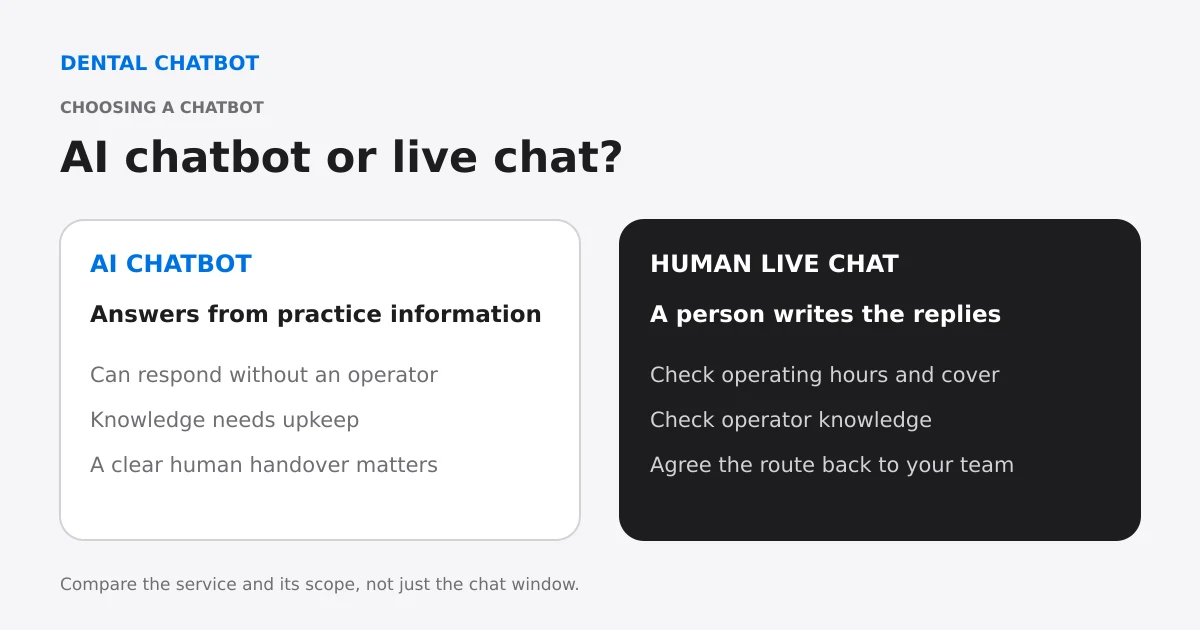
With live chat, a person writes the replies. That could be your own team or a managed service. Some services offer extended or round-the-clock cover; others only operate during specified hours. Find out who answers and what happens when no operator is available.
An AI chatbot can answer without a live operator, using information and instructions supplied for the practice. Its coverage still depends on service availability and a maintained knowledge base. A contact form or scripted question tree is different again: collecting details does not necessarily mean the system can answer a visitor's question.
These are descriptions of service types, not guarantees about every supplier. Ask to see the actual product in operation rather than buying on the label.
Compare the coverage you actually need
If your own reception team runs live chat, a busy telephone period can also become a busy chat period. Plan staffing and response expectations rather than assuming the extra channel will look after itself. An external service can provide cover, but needs an agreed scope and a route back to the practice.
AI may suit repeated website questions when your team is unavailable. It can explain approved hours, parking or booking steps without waiting for an operator. That does not remove the need for someone to review information, handle exceptions and respond to requests for contact.
- Check out-of-hours cover, response expectations and outage arrangements.
- Ask what happens when an answer is unknown or the visitor requests a person.
- Keep urgent-care signposting separate from routine sales follow-up.
Who has the information needed to answer well?
Your own team may know the subtleties of practice policies and recognise an existing patient's concern. An external operator needs that context documented. An AI assistant also needs approved information and limits on what it can infer.
Neither a human operator nor AI should guess a fee, promise an NHS place or decide that a visitor is suitable for treatment. The GDC requires practice publicity to be accurate and not misleading. [1] Put the same test questions to each supplier: an outdated price, a treatment you do not provide and a question with no approved answer.
Human conversation can be valuable when a visitor is confused or the situation needs judgement. A website chat channel, whoever answers it, is not a substitute for a clinical assessment.
Compare what reception receives, not just what visitors see
Both live-chat services and AI chatbots can qualify enquiries. Neither should be judged solely on how many names and numbers they capture. A visitor who only needs opening hours may be satisfied without a follow-up. A prospective patient discussing a consultation may need the team to respond.
Ask for sample handovers. Can your team see why the visitor contacted you, what was explained and whether they asked for a callback? Does an enquiry about private treatment remain distinguishable from an existing-patient administration question?
Dental Chatbot focuses on answering routine questions and qualifying website enquiries before handing over relevant contact details. That is a product approach to assess in a demonstration, not a claim that human live chat cannot do the same job.
Compare the full cost of the service
For in-house live chat, include the staff time needed to provide reliable cover. For managed live chat, ask about included hours, conversation limits and any extra charges. For AI, check usage allowances, overage pricing, setup, support and the work involved in maintaining information.
Avoid assuming that a lower subscription automatically produces a lower total cost. A cheaper service that creates unclear follow-ups may still require substantial reception time. Conversely, additional human cover may be worthwhile if it resolves conversations your practice needs handled personally.
Compare quotations against the same intended workload and service scope. Do not turn a token allowance into a guaranteed conversation count without a clearly defined and defensible basis.
Apply privacy checks to both options
Human live chat also processes personal information. Establish who can access conversations, where information goes and how long it is retained, regardless of whether the reply was written by a person or generated by AI.
For an AI service, ask about additional providers and the purposes for which conversation data is used. The ICO's AI guidance highlights the need to understand processing roles and manage risks throughout the service's use. [2] A privacy policy link is useful, but it does not replace reviewing the actual arrangements.
Run a fair comparison with your own questions
Use a small, repeatable set of fictional enquiries: opening hours, parking, an NHS question, a treatment enquiry, a request for a person and a question the service cannot answer. Check the replies and the resulting handovers on mobile as well as desktop.
You may choose AI for routine website questions and your team for personal follow-up. You may prefer a managed human service, or a combination with clear boundaries. The decision should follow your practice's needs rather than a claim that one technology is always better.
Sources
- [1]GDC: Guidance on advertising and accurate patient-facing information
- [2]ICO: Accountability and governance implications of AI
Published by the Dental Chatbot team as general practice-management information. It is not clinical, legal or data protection advice.
See how Dental Chatbot would work for your practice
Book a free demo to discuss your practice information, enquiry delivery and booking handoff.
Keep reading
- Practice operations · 5 min readAI receptionists for dental practices: what to expect
- Patient enquiries · 5 min readHandling NHS enquiries at a private dental practice
- Buying guide · 5 min readWhat to check before choosing a dental chatbot
- AI in practice · 6 min readAI for dental practices: a practical guide for UK owners
- Better patient enquiries · 6 min readHow a dental chatbot qualifies patient enquiries, not just leads