
Better patient enquiries
How a dental chatbot qualifies patient enquiries, not just leads
By Dental Chatbot team · · 6 min read
A dental chatbot should do more than ask every visitor for a name and telephone number. A person checking your closing time does not necessarily need a callback. Someone looking for an NHS place needs a clear answer about availability, not a sales lead that leaves your team explaining the same thing tomorrow.
The useful question is not simply whether a chatbot generates more leads. It is whether it helps visitors understand their options and gives your team better-qualified enquiries to follow up. Here is what that can look like on a dental practice website.
Key takeaways
- Answer a visitor's question before deciding whether a callback is useful.
- Explain availability honestly and offer relevant alternatives only when the practice provides them.
- Capture contact details with the visitor's interest and a clear next step.
What does patient enquiry qualification mean?
Enquiry qualification means establishing what a visitor is looking for and whether your practice can help with that request. It is not a clinical assessment and should not be used to decide whether someone is medically suitable for treatment.
For a dental website, useful context might include the treatment someone is interested in, whether they want information about private care and whether they would prefer a callback or your online booking link. That makes the handoff more useful than an unexplained name and number.
There are several good outcomes. A routine question can be answered without collecting details. An interested visitor can ask the team to contact them. Someone looking for an unavailable service can leave with accurate information rather than an expectation the practice cannot meet.
Answer common questions before asking for contact details
Opening hours, parking, location and published treatment information are natural starting points for a conversation. Requiring a telephone number before sharing those basics creates a follow-up task where a direct answer might have been enough.
Dental Chatbot uses the practice information you provide to answer common questions. If a visitor only wants to know whether there is parking, a clear answer can be the complete service they need. If they then ask about booking, the conversation can move towards an appropriate next step.
Dentistry's discussion of chatbots and patient experience describes the role of practice-specific information, self-service answers and access outside normal hours. Those are useful principles, but they are not a guarantee of a particular conversion rate or return for your practice. [1]
- Give the approved answer about parking, including charges or restrictions if relevant.
- Use current opening hours rather than an assumed closing time.
- Explain published prices carefully and make clear when an individual assessment is needed.
- Do not invent an answer when information has not been provided.
Handle NHS enquiries with clear expectations
An NHS enquiry is not a bad enquiry. It is a person asking for an option that your practice may or may not currently offer. The response should be helpful and accurate, even when it does not produce a lead.
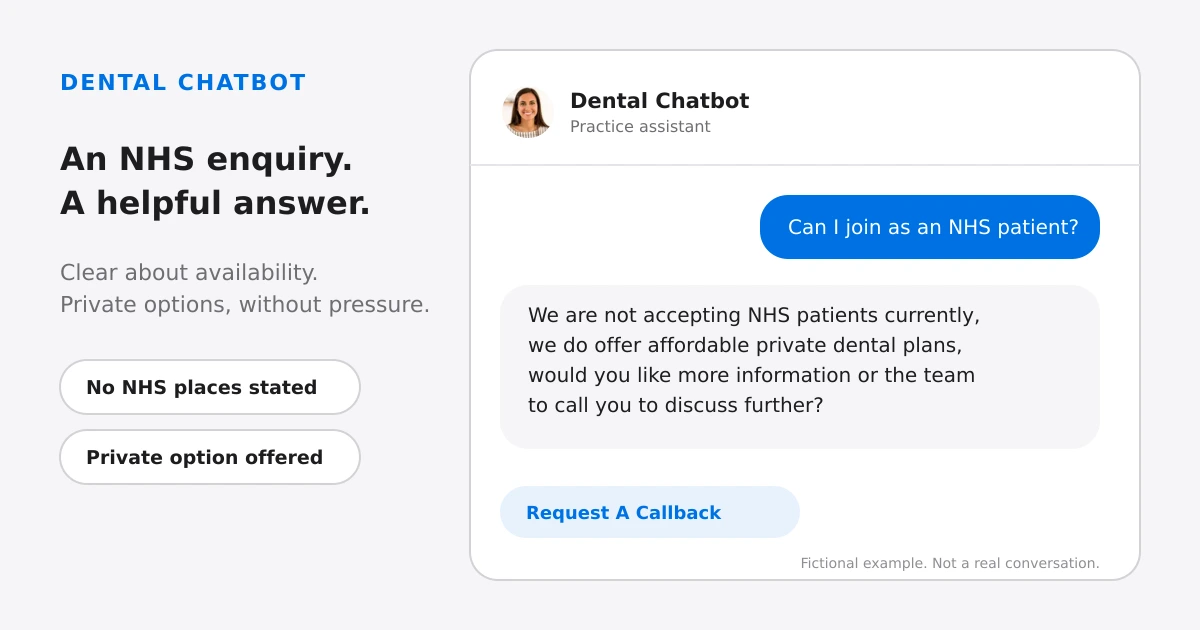
Consider a fictional practice that is not accepting new NHS patients but does have a private membership plan. Its approved response could say: 'We are not currently accepting new NHS patients. We do offer private dental plans. Would you like the team to explain those options?'
The important detail is that the alternative is real and the visitor has a choice. If the practice has no such plan, the chatbot must not invent one. If NHS availability varies, the answer should reflect the information the practice has approved, rather than promise a place.
This is where qualification differs from collecting every contact. A visitor who wants to explore private care can choose a callback. A visitor who only wants NHS care can receive an honest answer without an unnecessary sales call.
Help interested visitors take a suitable next step
A prospective Invisalign or dental implant patient may have questions before they are ready to speak to someone. Your chatbot can introduce the treatment information the practice has approved, explain the consultation route and offer a handoff.
It should not claim that the visitor is suitable for a treatment, diagnose a condition or guarantee a result. Those decisions belong with appropriately qualified professionals. Website enquiry qualification is about understanding interest, not replacing an assessment.
The next step might be your online booking system, such as Dentally or SOE, or a request for the team to call. Agree how this will work for your practice. Directing someone to a booking page is different from confirming an appointment or writing into a practice diary.
Make the lead useful to the reception team
When a visitor does want a response, capture the details needed for that next step and enough context to explain the enquiry. Ask what your team genuinely needs to act, rather than using the chat to gather a full medical history.
Dental Chatbot can arrange lead delivery by real-time email, Google Sheets and/or CRM integration. Confirm your preferred setup during onboarding, including who receives enquiries and how the team will follow them up.
The ICO's AI guidance highlights transparency, minimisation and accountability among the relevant data protection principles. Decide how conversations and lead records are handled, restrict access appropriately and review your privacy information. A product label is not a substitute for those decisions. [2]
A prompt, relevant follow-up still matters. Even a well-qualified enquiry will not turn into a useful conversation if nobody owns the next action.
Judge the chatbot by more than the number of leads
Review whether enquiries fit the services and patient options you offer, whether routine questions are resolved accurately and whether the team has the context needed to respond. Track actual booking outcomes where your systems and permissions allow you to do so.
Saving reception time can be a valuable supporting benefit. The main aim is a better first conversation: useful answers for the visitor and an appropriate next step for the practice. Fewer unnecessary callbacks can be a positive result even if the raw lead count does not rise.
If you are comparing tools, test realistic questions with fictional data. Ask about NHS availability, parking, a treatment you do not provide and a fee that is missing from the knowledge base. The handling of those questions matters as much as the polished demonstration.
See Dental Chatbot in action
Our website demonstration shows how Emma answers everyday questions and responds to an NHS enquiry with a relevant private alternative. You can enter fictional practice details to see the same conversation use different opening hours, parking information and availability.
The demonstration is a scripted example, not evidence that an appointment has been booked. For a walkthrough of the real service, book a free demo and discuss your practice information, enquiry delivery and booking handoff with the team.
Sources
- [1]Dentistry: Chatbots, improving patient experience (13 July 2023)
- [2]ICO: Guidance on AI and data protection, about this guidance
Published by the Dental Chatbot team as general practice-management information. It is not clinical, legal or data protection advice.
See how Dental Chatbot would work for your practice
Book a free demo to discuss your practice information, enquiry delivery and booking handoff.
Keep reading
- Practice operations · 5 min readAI receptionists for dental practices: what to expect
- Choosing a chatbot · 5 min readAI dental chatbots versus live chat: which suits your practice?
- Patient enquiries · 5 min readHandling NHS enquiries at a private dental practice
- Buying guide · 5 min readWhat to check before choosing a dental chatbot
- AI in practice · 6 min readAI for dental practices: a practical guide for UK owners