
Patient enquiries
Handling NHS enquiries at a private dental practice
By Dental Chatbot team · · 5 min read
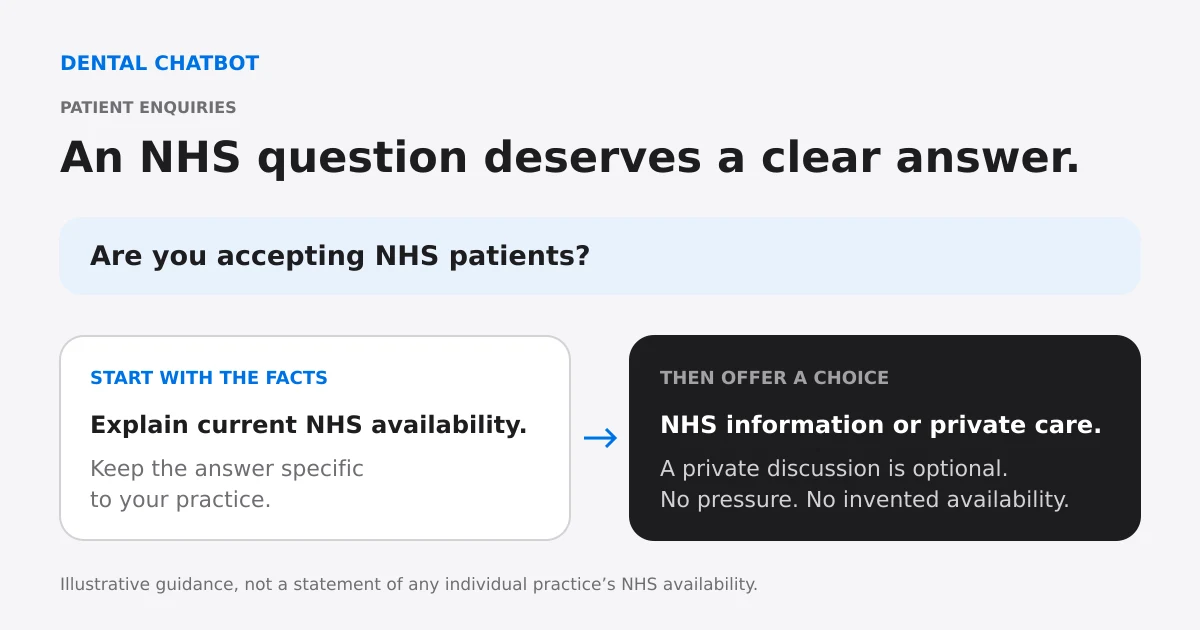
An NHS enquiry is not a nuisance enquiry. It is usually someone trying to understand whether they can access care. If your practice is wholly private, or cannot currently offer the NHS appointment requested, a clear answer helps the visitor and prevents an avoidable exchange with reception.
For practice owners, the aim is to separate three things: an accurate statement of NHS availability, useful signposting for people seeking NHS care and an optional discussion of private services. A website chatbot can support that process, but it should not blur those choices.
Key takeaways
- Describe the practice's actual NHS position, including any relevant exceptions.
- Private care or a dental plan is an option to explain, not a substitute to disguise as NHS care.
- Do not turn an urgent concern into a routine sales callback.
Be precise about what your practice can offer
A wholly private practice and a mixed practice that is not taking new NHS adults need different wording. There may also be different arrangements for existing patients, children or particular services. Agree the exact answer with the person responsible for your practice's NHS arrangements.
The GDC says practice publicity must make clear whether the practice is NHS, mixed or wholly private, and information must be accurate and current. [1] Apply that standard to chat replies as well as your main website pages.
Keep the chatbot, reception scripts and public listings consistent. Do not let an old response continue saying that appointments are unavailable after your position changes, or imply that a waiting list exists unless you actually maintain one.
Answer the question before asking for contact details
A person asking whether you accept NHS patients should not need to supply a phone number just to discover that you cannot offer the service. Give the availability answer first. Then ask which, if any, next step would help.
For a fictional mixed practice that is not accepting new NHS patients but does offer private plans, an example could be: 'We are not currently taking new NHS patients. If you would like to explore private care, our team can explain the dental plans we offer. Would you like a callback?'
That wording is an illustration, not a script to copy into every practice. If you do not offer plans, remove that option. If you accept the kind of NHS appointment being requested, explain the actual route to your team instead of steering the visitor to private care.
Make private options clear and genuinely optional
A membership plan may help someone understand how routine private care is paid for, but it is not NHS dentistry. Explain what a plan includes, what it excludes, relevant eligibility conditions and the actual fees using approved practice information. Do not assume that implants, cosmetic treatment or all emergency care are included.
A chatbot can ask whether someone would like more information. It should not present a monthly fee as evidence that care is affordable for that individual, imply that joining guarantees treatment, or make a clinical recommendation.
The GDC asks for balanced, factual information and warns against exploiting patients' vulnerability or lack of knowledge. [1] A helpful conversation gives someone a choice without repeatedly pushing a private option after they have declined.
Offer useful NHS signposting for the relevant nation
For practices in England, the NHS website explains how to find an NHS dentist and contact practices about appointments. It also explains that completing a registration form does not guarantee future NHS care at that practice. [2] Avoid telling visitors that finding an NHS appointment works exactly like registering with a GP.
The same NHS guidance says that people unable to find an appointment can contact their local integrated care board for help identifying local options. [2] Signpost to current official information rather than suggesting another practice has capacity you have not checked.
Those links relate to England. Practices in Scotland, Wales and Northern Ireland should use the appropriate official service information for their nation and local area, rather than automatically reusing an English NHS pathway.
Keep urgent-care concerns out of the sales journey
An enquiry about NHS availability can also contain a request for urgent help. The assistant should not diagnose the problem, decide that it can wait or place the visitor into an ordinary lead-follow-up sequence as the only response.
Have your clinical lead approve clear urgent-care signposting and the route to human assistance. In England, the NHS urgent dental page explains when to contact a dentist or NHS 111 and when emergency help is needed. [3] Use the appropriate official pathway for your location.
Do not promise a callback time that the practice cannot meet, particularly when the conversation happens overnight. Make the limitations of a website enquiry channel clear.
Capture details only when there is a useful follow-up
When a visitor asks to discuss private care, explain why you need their details and collect only what the team needs to contact them. Keep the original enquiry visible so reception knows the conversation started with an NHS question.
Do not classify that person as ready to purchase a treatment or as unsuitable for care. An enquiry category helps administration; it is not a clinical judgement. Someone who declines a private discussion should still receive the relevant information without being forced into a callback.
Review how unexpected health information is handled, who can see transcripts and how long records are kept. ICO guidance emphasises accountable AI governance and understanding the roles of the organisations processing information. [4]
Test the different answers before launch
Use fictional examples covering an existing NHS patient, a prospective new adult patient, a parent asking about a child, someone who wants private information and someone who declines it. Check that each answer matches your actual policy and does not manufacture availability.
Dental Chatbot's website demonstration lets you change the example practice's NHS setting and see a different conversation. Use that as a starting point for discussing your real requirements, not as a substitute for approving your own patient-facing information.
Sources
- [1]GDC: Guidance on advertising, NHS status and balanced patient information
- [2]NHS: How to find an NHS dentist in England
- [3]NHS: How to find an emergency or urgent NHS dentist appointment
- [4]ICO: Accountability and governance implications of AI
Published by the Dental Chatbot team as general practice-management information. It is not clinical, legal or data protection advice.
See how Dental Chatbot would work for your practice
Book a free demo to discuss your practice information, enquiry delivery and booking handoff.
Keep reading
- Practice operations · 5 min readAI receptionists for dental practices: what to expect
- Choosing a chatbot · 5 min readAI dental chatbots versus live chat: which suits your practice?
- Buying guide · 5 min readWhat to check before choosing a dental chatbot
- AI in practice · 6 min readAI for dental practices: a practical guide for UK owners
- Better patient enquiries · 6 min readHow a dental chatbot qualifies patient enquiries, not just leads