
Buying guide
What to check before choosing a dental chatbot
By Dental Chatbot team · · 5 min read
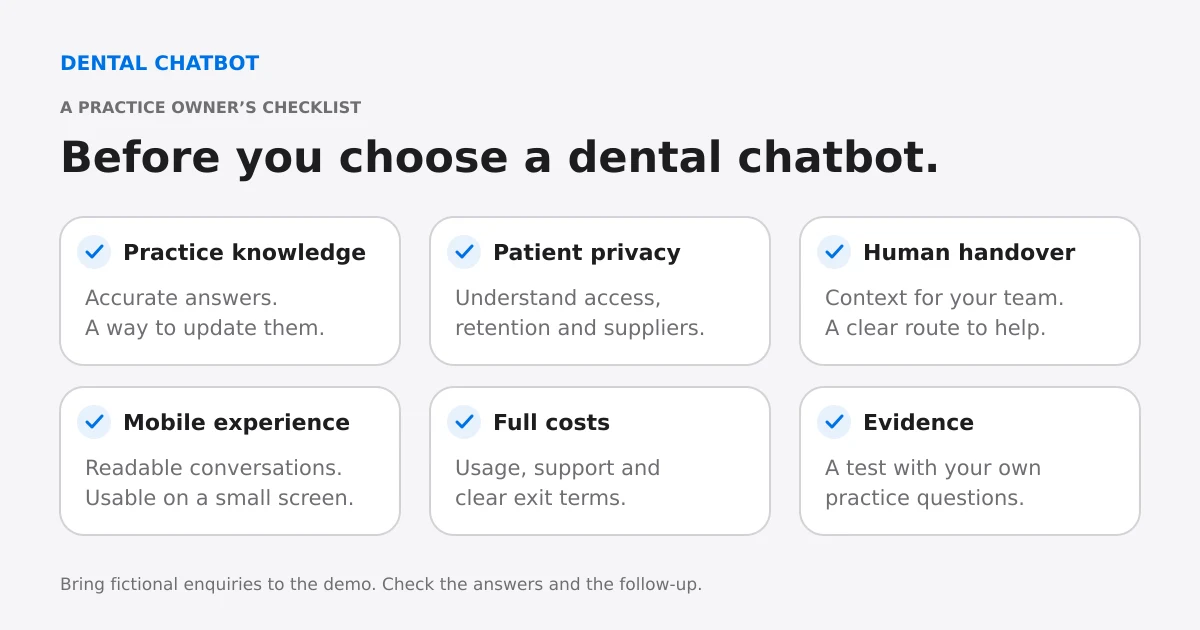
A polished demonstration is a useful introduction, but it is not enough to choose a dental chatbot. You need to know what happens when someone asks an awkward question, when your fees change and when a visitor wants to speak to a person.
Use the same checklist with every supplier, including us. Bring your practice information, a handful of fictional enquiries and the people who will handle the resulting follow-ups. A good buying conversation should make the limitations as clear as the benefits.
Key takeaways
- Test the system with your own questions, including information it should not guess.
- Separate booking links, enquiry capture and confirmed appointment integrations.
- Review the full cost, data arrangements and ongoing work, not just the headline subscription.
1. Agree what the chatbot is supposed to do
List your priorities before comparing demonstrations. You might need routine questions answered, better-qualified treatment enquiries, clearer NHS responses or a route to online booking. Decide which outcomes matter most and which conversations must always reach a person.
Confirm whether the product covers website visitors, telephone calls or other channels. A website chatbot does not automatically include a voice receptionist, clinical advice or access to patient records. Broad descriptions such as 'handles reception' need translating into specific tasks.
2. Test knowledge and the limits of its answers
Ask about your actual opening hours, a starting fee, parking and NHS availability. Then ask about something you have not supplied. The assistant should be able to acknowledge that it does not know, rather than invent a convincing answer.
Ask how information is approved and updated. Can a named member of your team change a fee or a closing time? How is an outdated answer identified and corrected? The GDC requires accurate, current and non-misleading patient-facing information, so maintenance is part of the purchase, not an optional extra. [1]
- Try a treatment your practice does not offer.
- Ask whether a guide price guarantees a personalised treatment cost.
- Check different NHS policies rather than a single yes-or-no sales example.
3. Inspect the enquiry your team receives
Request a complete example from first question to follow-up. Check whether reception receives the visitor's area of interest and the relevant conversation context alongside their details. Find out whether the delivery route is email, a spreadsheet, your CRM or another agreed destination.
Then ask what happens when delivery fails, a contact detail is wrong or the usual staff member is absent. Decide who owns follow-up within your practice. A system that collects details successfully can still create a poor experience if no one takes responsibility for the next step.
4. Ask what booking integration actually means
There is a practical difference between opening a Dentally or SOE booking link, sending an appointment enquiry and reading or writing a live appointment book. Ask the supplier to demonstrate the exact connection supported by your setup.
Check when an appointment is genuinely confirmed and what the patient is told before that point. A visitor should not leave a chat believing they have a reserved appointment when they have only requested contact. Do not assume a practice-management-system logo proves a particular integration.
5. Review data protection before collecting details
Ask for the relevant data processing terms, the organisations involved, access controls, retention arrangements and the process for handling access or deletion requests. Check where information is stored or accessed and what safeguards apply to any international transfers.
Find out whether conversation data is used for model training or other secondary purposes. A description such as 'trained on your practice information' does not answer that question. The actual processing determines organisations' roles, and those arrangements need to be understood and documented. [2]
Assess whether a data protection impact assessment is required for your proposed use. ICO AI guidance is being reviewed following legislative changes, so check current guidance and seek appropriate advice for your circumstances rather than treating this checklist as legal sign-off.
6. Use it on a phone and ask for a person
Open the chat on a small screen. Check whether text is readable, fields are usable, the on-screen keyboard causes problems and the widget blocks essential website controls. Visitors should be able to close it and continue using your website.
Ask directly to speak to a person. Test uncertainty, a complaint and an urgent-care question using fictional information. Confirm the approved limits and routes to help. Do not evaluate a non-clinical website assistant as if it can diagnose symptoms or decide whether treatment is safe to delay.
7. Compare costs, support and exit terms
Check setup fees, subscription charges, included AI usage, overage pricing, contract terms and support. Ask what happens if usage rises and whether you can see the information needed to understand charges. A token allowance is not a fixed number of patient conversations.
At the time of writing, Dental Chatbot is £250 per month with no setup fee, a month-to-month contract and cancellation with 30 days notice. It includes £75 of AI token usage per month, with usage above that charged at cost price. Check the current pricing before making a decision.
Also establish who helps with installation, how changes are requested and what happens to enquiries and transcripts when the service ends. A low subscription is not the whole cost if the arrangement leaves substantial work with your team.
8. Bring a short test list to the demonstration
Use fictional details and test one simple question, one treatment enquiry, one NHS enquiry, one unknown answer and a request for human help. Ask to see the resulting transcript or enquiry summary and the actual delivery route.
After launch, review accuracy, relevant follow-ups, delivery reliability and the work created for reception. Count appointments only when they are confirmed through your normal process. Choose a supplier that can explain how you will assess those outcomes, not one that asks you to judge success by conversation totals alone.
Sources
- [1]GDC: Guidance on advertising and maintaining accurate practice information
- [2]ICO: Accountability, processing roles and governance implications of AI
Published by the Dental Chatbot team as general practice-management information. It is not clinical, legal or data protection advice.
See how Dental Chatbot would work for your practice
Book a free demo to discuss your practice information, enquiry delivery and booking handoff.
Keep reading
- Practice operations · 5 min readAI receptionists for dental practices: what to expect
- Choosing a chatbot · 5 min readAI dental chatbots versus live chat: which suits your practice?
- Patient enquiries · 5 min readHandling NHS enquiries at a private dental practice
- AI in practice · 6 min readAI for dental practices: a practical guide for UK owners
- Better patient enquiries · 6 min readHow a dental chatbot qualifies patient enquiries, not just leads