
Practice operations
AI receptionists for dental practices: what to expect
By Dental Chatbot team · · 5 min read
A prospective patient visits your website after dinner. They want to know whether you see new private patients, what a first appointment involves and whether there is parking. Your phones are closed, but their questions are not complicated.
An AI receptionist can help with that first conversation. The useful question for a practice owner is not whether AI can sound friendly. It is whether the assistant gives accurate answers, recognises the limits of its role and passes worthwhile enquiries to a team that can act on them.
Key takeaways
- A website AI receptionist and a telephone answering service are different purchases.
- Useful answers depend on current, approved practice information and clear boundaries.
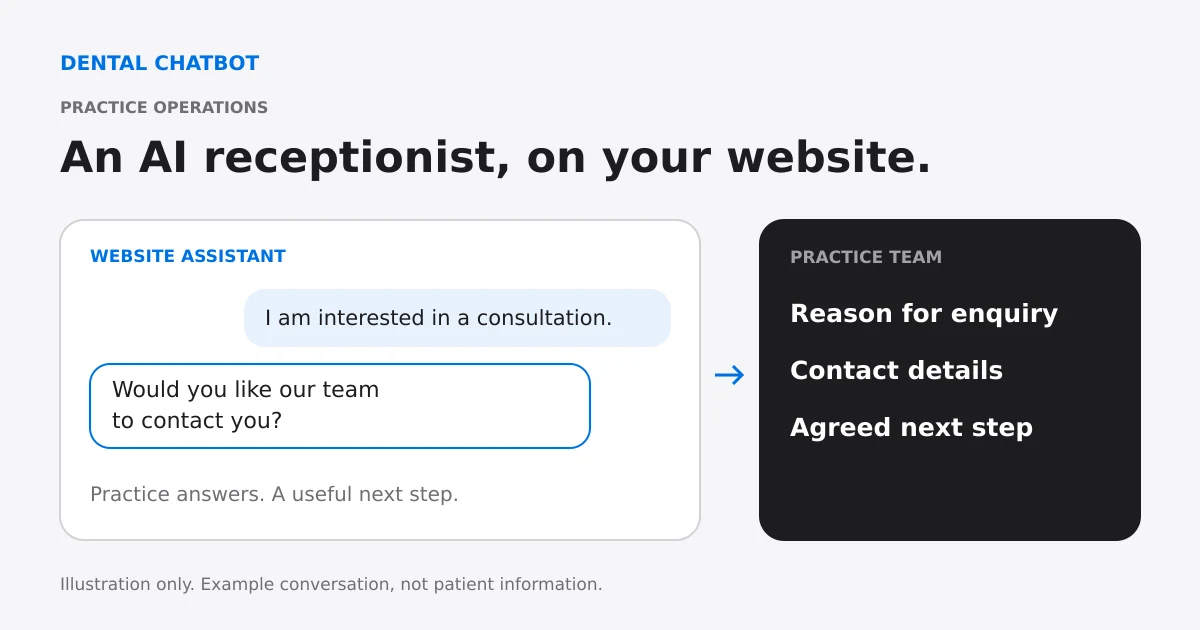
- A good handover includes the reason for the enquiry, not just contact details.
First, check which reception desk you are buying
The phrase AI receptionist can describe a website chatbot, a voice system that answers telephone calls, or a combination of services. Those products have different implementation needs. A website assistant does not automatically answer your telephone, see your appointment book or make changes to patient records.
Dental Chatbot is a website assistant. It welcomes visitors, answers questions using practice information, helps qualify enquiries and guides people towards an appropriate next step. If telephone cover is your priority, evaluate that requirement separately rather than assuming it is included.
Start with the conversations your team knows well
Opening hours, directions, accessibility and parking are sensible starting points. The assistant can also explain which treatments the practice offers and describe the next step for someone considering a consultation. These are information tasks, not clinical assessments.
Give fee information the same attention you would give your website price list. A starting price should remain a starting price, with any relevant conditions explained. A chatbot should not turn an advertised guide fee into a personalised quotation or tell someone that a treatment is suitable for them. The GDC expects dental publicity to be accurate, current and not misleading. [1]
- Use actual opening hours, including exceptions and bank holidays.
- Explain whether a fee is a guide, a starting price or a fixed charge.
- Keep NHS availability and private-plan information separate and current.
Not every useful conversation should become a lead
Someone asking where to park may only need directions. Making that person leave a telephone number adds work without improving their experience. Someone asking about a treatment may welcome a callback after receiving a basic explanation of the consultation process.
Qualification means understanding that difference. Ask whether the person wants the team to contact them, and capture enough context to make that conversation useful. Do not treat a request for information as agreement to an appointment, or a mention of a treatment as evidence that it is clinically appropriate.
For an NHS enquiry, the correct answer depends on the practice. A wholly private practice, a mixed practice with limited availability and a practice accepting new NHS patients need different responses. An optional private discussion is only relevant when the service genuinely exists.
Prepare the information before switching it on
Appoint one person to approve the initial knowledge and keep it up to date. Collect the details reception already uses: contact information, hours, treatments, fees, team information, booking links and agreed wording for questions the assistant cannot answer.
Then test awkward cases, not just easy ones. Ask about a treatment you do not offer, a fee that is not listed and an NHS appointment you cannot provide. The assistant should acknowledge uncertainty or route the visitor to the team rather than fill a gap with a plausible answer.
Decide what happens after the conversation
A saved enquiry is not the same thing as a completed handover. Agree where enquiries arrive, who checks them, how quickly the practice aims to respond and what happens when the usual person is away. Include the visitor's question or area of interest alongside their chosen contact details.
Check booking claims carefully. Sending someone to your existing booking system is different from reserving a slot or confirming an appointment. Ask the supplier to demonstrate exactly what the visitor sees and exactly what your team receives.
Keep privacy and clinical boundaries visible
Visitors may volunteer health information even when you only ask for a name and contact details. Plan for that possibility. Review access permissions, retention, deletion, supplier responsibilities and the information shown to visitors before collecting data.
The ICO stresses that AI governance and accountability cannot simply be delegated to a technical supplier. Assess the risks, consider whether a data protection impact assessment is required and keep suitable human oversight. [2]
A website assistant should not diagnose symptoms or reassure someone that waiting for a routine callback is safe. Have a clinical lead approve the route for urgent concerns and the wording used when a human needs to take over.
Pilot it against a small set of useful outcomes
During an initial review period, sample conversations for accuracy and note which enquiries the team could act on. Compare routine questions resolved, relevant follow-ups requested and appointments actually confirmed by your normal process. Conversation volume alone does not tell you whether the assistant is helping.
Dental Chatbot is designed around these website conversations. Try the practice configurator with your own information, then use a live demonstration to check knowledge setup and the handover your team would use.
Sources
- [1]GDC: Guidance on advertising, including accurate and current practice information
- [2]ICO: Accountability and governance implications of AI
Published by the Dental Chatbot team as general practice-management information. It is not clinical, legal or data protection advice.
See how Dental Chatbot would work for your practice
Book a free demo to discuss your practice information, enquiry delivery and booking handoff.
Keep reading
- Choosing a chatbot · 5 min readAI dental chatbots versus live chat: which suits your practice?
- Patient enquiries · 5 min readHandling NHS enquiries at a private dental practice
- Buying guide · 5 min readWhat to check before choosing a dental chatbot
- AI in practice · 6 min readAI for dental practices: a practical guide for UK owners
- Better patient enquiries · 6 min readHow a dental chatbot qualifies patient enquiries, not just leads