
AI in practice
AI for dental practices: a practical guide for UK owners
By Dental Chatbot team · · 6 min read
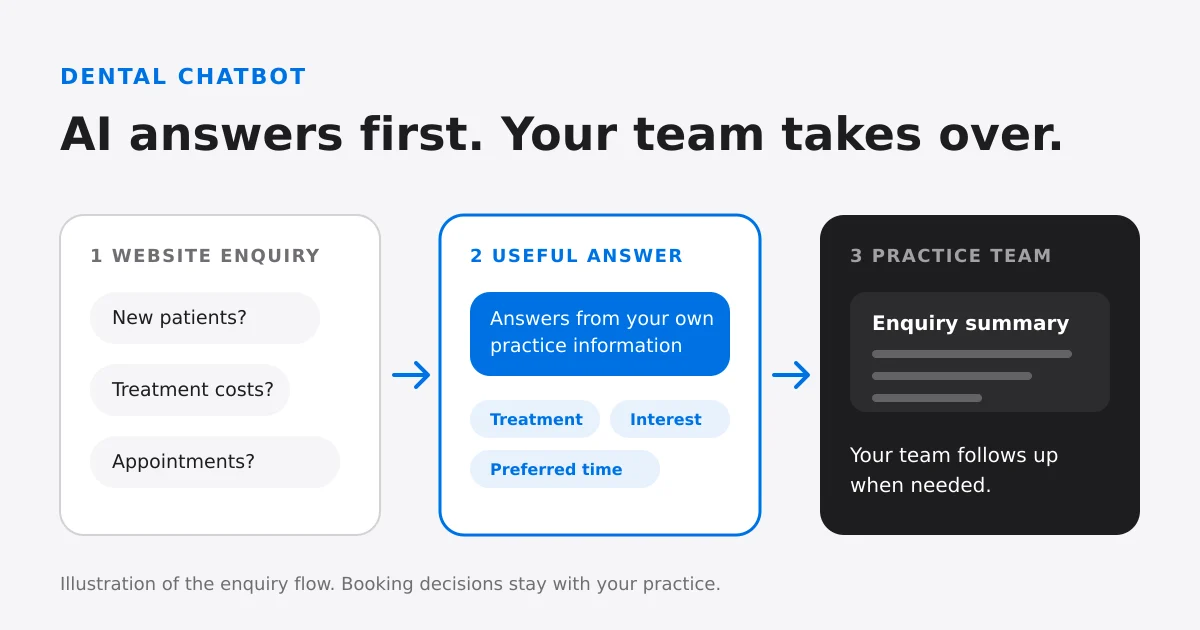
Before adding AI to your dental practice, look at the enquiries your team already handles. Which people need a conversation about treatment, and which just need an answer about parking or opening hours?
Consider three website visitors: someone looking for an NHS place, someone asking about an Invisalign consultation and someone checking where to park. Asking all three to leave a phone number creates a list of contacts, but it does not necessarily help them or your reception team. A useful AI receptionist should answer what it can and recognise when a person needs to take over.
Key takeaways
- Answer straightforward questions before asking a visitor for their contact details.
- Check fee wording, NHS availability and the route to your team before launch.
- Judge the quality of enquiries and answers, not just the number of conversations.
First, separate clinical AI from help with enquiries
AI for dental practices covers different jobs. A tool used to help assess a radiograph needs a different evaluation from software that drafts an internal document or answers a website question. Be specific about the job you are buying it to do.
The GDC's 2025 rapid evidence assessment looked at real-world clinical use of AI in dental services and identified gaps in the evidence. That research is not an endorsement of website chatbots or evidence that they improve clinical outcomes. [1]
For a website assistant, the job is narrower: explain approved practice information, understand what the visitor is asking about and offer a suitable next step. Diagnosis and treatment recommendations remain with qualified clinicians.
Sometimes the right result is an answer, not a lead
A visitor who finds out where to park may have everything they need. There is no reason to make reception call them just to repeat that answer. Someone considering a treatment may need more information before deciding whether they want a conversation with your team.
NHS enquiries need particular care. In a fictional example, a practice has no new NHS places but does offer a private membership plan. Its chatbot could explain the NHS position, outline the private option and ask whether the visitor would like a callback. If they do not, the conversation can end there.
That only works if the answer reflects the practice. Do not offer a plan you do not provide, suggest an NHS place is available when it is not, or treat every visitor as a private treatment lead.
Prepare the answers before switching it on
Start with the information your reception team uses, rather than assuming an AI model already knows your practice. Your website, team and chatbot should give the same answers.
Fees are a useful test. If a treatment has a starting price, the chatbot should preserve that qualification rather than present it as a fixed quote. If the actual cost depends on an assessment, say so.
Give one person responsibility for approving updates. A fee change, bank holiday closure or change in new-patient availability should trigger the same check across your website and chatbot.
- Opening hours: include exceptions, not just the usual weekly timetable.
- Location and parking: distinguish onsite spaces from nearby parking, including any charges or restrictions.
- Treatments and fees: use approved descriptions and retain any conditions attached to published prices.
- NHS and private care: confirm which patient categories you are currently accepting.
- Next steps: check that booking links work and callback requests reach the right team.
Know what happens to the conversation
Ask the supplier to explain what is collected, where it is processed, who can access it and when it is deleted. Include what happens if a visitor types health information without being asked. A short website enquiry can still involve sensitive details.
The ICO's AI and data protection guidance sets out a risk-based approach, including transparency, data minimisation, accuracy and accountability. Using an AI supplier does not remove your responsibilities as a practice. Check the current guidance and take appropriate advice for your setup. [2]
Visitors should know they are speaking to an automated assistant and how to reach the practice team. Set clear boundaries for clinical questions, complaints and urgent concerns. A marketing enquiry is not the place to ask for a medical history.
Five questions to try before launch
Do not test only the questions with easy answers. Try the examples below against your approved practice information, then check both the reply and any handoff to reception. These are suggested tests, not a record of patient conversations.
- Are you accepting NHS patients? The answer should reflect current availability, not a general description of NHS dentistry.
- How much does Invisalign cost? Check that the reply uses approved fee wording and explains when an assessment is needed.
- Do you have step-free access? If that information has not been supplied, the assistant should not guess. It should direct the visitor to the team.
- Can you guarantee the treatment will work? It should not make promises about an individual clinical outcome.
- Could someone call me? Check that the visitor can choose a callback, provide the necessary contact details and give the team a useful reason for calling.
Check what reception actually receives
A report showing more chats does not tell you whether reception has better enquiries to follow up. Compare the messages your team receives before and after launch, using your privacy and access arrangements.
Ask the team whether the visitor wanted a service you offer, whether the reason for the enquiry was clear and whether they had to ask for information the chatbot had already collected. Look for repeated questions that need a better answer in your practice information.
Also count a routine question answered correctly as a useful outcome, even when it produces no lead. Treatment conversion, time savings and financial returns need to be measured in your practice; they are not guaranteed by adding a chatbot.
- Relevance: does the enquiry concern care the practice can offer?
- Context: can reception understand why the person wants a call?
- Accuracy: did the conversation set the right expectations about fees and availability?
- Follow-up: was the enquiry delivered to the agreed destination?
Where Dental Chatbot fits
Dental Chatbot was developed with leading independent UK dental practices and a prominent dental marketing agency. It is a website-based AI receptionist, tailored with practice information such as fees, opening hours, treatments and team details. You can personalise its name, avatar and colours.
It works 24/7 to answer common questions, generate and qualify enquiries, capture contact details when someone wants to take the next step and guide visitors to your existing online booking. Enquiries can be delivered through real-time email, Google Sheets and/or CRM integration, depending on the agreed setup.
During a demo, bring a few questions your reception team regularly handles. Ask to see how they would be answered and what the team would receive afterwards. Check the booking handoff too: a website conversation is not a voice answering service or a confirmed appointment in your diary.
Sources
- [1]GDC: Artificial Intelligence in Dental Service Provision, Rapid Evidence Assessment (12 August 2025)
- [2]ICO: Guidance on AI and data protection, about this guidance
Published by the Dental Chatbot team as general practice-management information. It is not clinical, legal or data protection advice.
See how Dental Chatbot would work for your practice
Book a free demo to discuss your practice information, enquiry delivery and booking handoff.
Keep reading
- Practice operations · 5 min readAI receptionists for dental practices: what to expect
- Choosing a chatbot · 5 min readAI dental chatbots versus live chat: which suits your practice?
- Patient enquiries · 5 min readHandling NHS enquiries at a private dental practice
- Buying guide · 5 min readWhat to check before choosing a dental chatbot
- Better patient enquiries · 6 min readHow a dental chatbot qualifies patient enquiries, not just leads