
Buying guides
5 best dental chatbots for UK dental practices
By Dental Chatbot team · · 9 min read
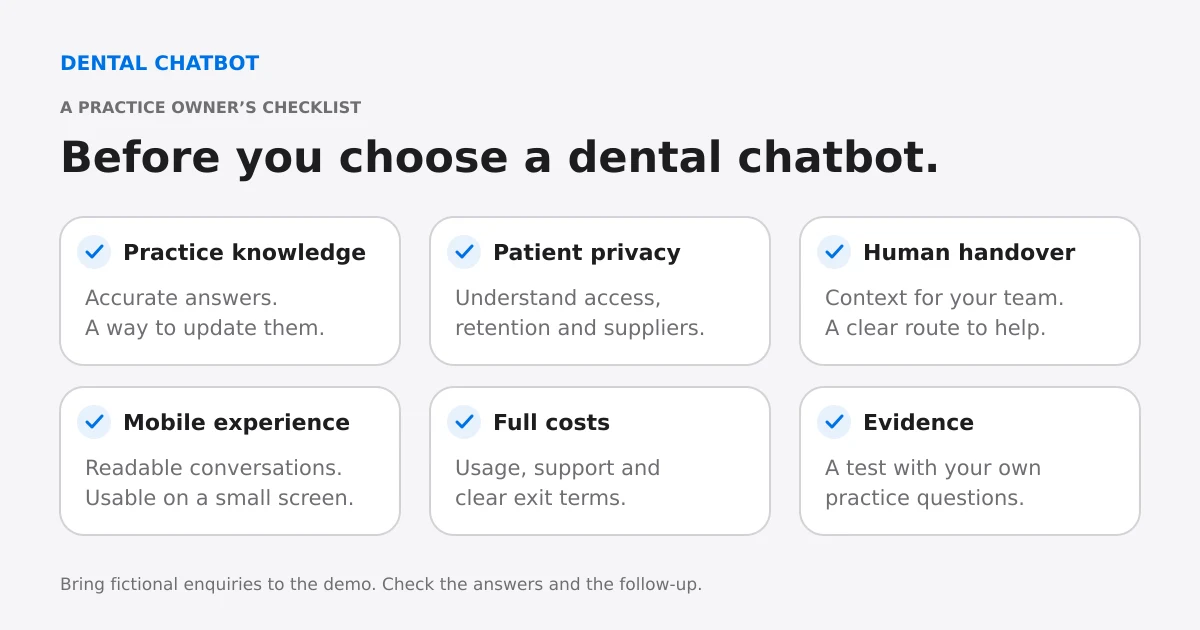
Another contact in the inbox is not always another useful patient enquiry. Someone asking about parking may just need an answer. Someone looking for an NHS appointment may need a clear explanation of your availability. Someone interested in implants may be ready for a conversation with your treatment coordinator.
The best dental chatbots for your shortlist should help distinguish those situations. This guide compares five website chatbot options for UK dental practices, with Dental Chatbot as our first choice for practices prioritising better-qualified website enquiries.
Disclosure: we make Dental Chatbot. This is our own editorial shortlist, not an independent award, an exhaustive market survey or a hands-on benchmark of every product. Competitor descriptions are based on their public product pages checked on 30 October 2026. Features, prices and plan requirements can change.
Key takeaways
- Our number-one pick is Dental Chatbot for its focus on answering practice questions and qualifying website enquiries before handing them to your team.
- DenGro is worth considering if your enquiry workflow already centres on its dental CRM.
- Dentistry Dashboard, TheDentalBot and Tidio Lyro offer different approaches to knowledge, enquiry management and human handover.
- Ask every supplier to demonstrate an NHS enquiry, an unanswered question and a complete handover using fictional details.
- Compare the full ongoing cost and data protection terms, not just a headline subscription.
How we chose these five chatbots for dental practices
We focused on website conversations, rather than telephone receptionists, clinical note-taking tools or diagnostic software. The shortlist includes dental-specific products and one general-purpose AI customer-service platform so that practice owners can compare the two approaches.
Our priorities are relevance to UK practice enquiries, control over practice information, useful lead qualification, a clear human handover and understandable costs. The ordering reflects those editorial priorities, not measured conversion rates. We have not independently verified competitors' performance or security claims.
In brief: Dental Chatbot is our pick for qualification-led website conversations; DenGro for a DenGro-centred workflow; Dentistry Dashboard for website knowledge import and an internal enquiry board; TheDentalBot for practice-specific and multilingual enquiries; and Tidio Lyro for a broader customer-service platform. These are suggested use cases, not exclusive capabilities.
1. Dental Chatbot: our pick for better-qualified patient enquiries
Dental Chatbot is built around a problem practice owners recognise: more enquiries are only useful if the team can do something worthwhile with them. It uses your practice information to answer website questions, identify what a visitor needs and guide them towards a relevant next step. That might be an answer, an online booking link or a callback request, rather than collecting details from every visitor regardless of intent. [1]
Consider a practice that is not accepting NHS patients. Its chatbot should explain that accurately. If the practice offers an appropriate private dental plan, it can introduce that option and ask whether the visitor wants more information or a call. It should not suggest an NHS appointment is available, or assume every person asking about NHS care wants private treatment.
Your approved knowledge can cover fees, treatments, opening hours, parking and team information. The receptionist's name, avatar and colour scheme can match your website. Conversation transcripts and analytics help your team understand what people asked, while enquiries can be delivered by real-time email, Google Sheets and/or CRM, with the required route agreed during setup.
The price is £250 per month with no setup fee. It is a month-to-month service with 30 days' notice to cancel. The plan includes £75 of AI token usage per month; usage above that allowance is charged at cost price. This is a usage allowance, not a guaranteed number of chats. [1]
Why we put it first: for a UK practice seeking a dedicated website assistant, we prioritise the combination of practice-specific answers, enquiry qualification and context for follow-up. That does not make it the cheapest option or the right fit for every practice. If you need a telephone receptionist or direct appointment creation inside your practice-management system, establish those requirements separately: sending someone to an online booking system is not the same as writing into a live appointment diary.
- Suggested fit: practices that want to distinguish worthwhile treatment enquiries from simple questions or unsuitable requests.
- Ask in your demo: show how an NHS enquiry, a missing price and a callback request are handled.
- Confirm before buying: your enquiry destination, knowledge-update process, usage billing and data protection agreement.
2. DenGro: consider it for a DenGro-centred enquiry workflow
DenGro's dental AI chatbot is included with its Pro Plan. Its product page describes treatment enquiries passing automatically into the Today page in DenGro, so staff can follow up within the CRM rather than manually copying details between systems. It also describes practice branding, proactive messages on particular website pages and a live-chat option for team members when available. [2]
That makes it a logical candidate if DenGro already sits at the centre of your lead management. Keeping website conversations and follow-up together may matter more to you than purchasing a separate chatbot.
Check the full Pro Plan cost rather than interpreting an included chatbot as a standalone free service. Ask the supplier to demonstrate the conversations your practice actually receives, how updates are requested and what a staff member sees when taking over. The public feature list is a starting point, not evidence that every requested workflow is included.
- Suggested fit: practices using, or actively considering, DenGro CRM.
- Published detail: chatbot included with Pro Plan, with no chatbot build fee stated.
- Confirm before buying: total CRM subscription, live-chat staffing and the enquiry fields passed to your team.
3. Dentistry Dashboard: consider it for knowledge import and an enquiry board
Dentistry Dashboard describes a dental AI chatbot that imports public website information into a knowledge base. Practices can review and edit that content, exclude pages and choose a tone of voice. Its page also describes captured contacts becoming cards on an internal kanban Leads board, with returning contacts matched by email or phone. [3]
At the time of checking, the page advertised an AI Chatbot option at £99 per month per practice location, alongside a wider Practice Hub bundle. It also described standalone availability by contacting the supplier. Confirm the applicable package, tax treatment, usage terms and implementation scope before comparing it with a written quote.
Website import can be convenient, but importing an old fee or an outdated NHS statement is still importing the wrong information. Ask who reviews the initial knowledge and how corrections reach the chatbot. If your team needs an external CRM, check carefully: the page specifically describes leads staying inside Dentistry Dashboard rather than being pushed to HubSpot or Salesforce. [3]
- Suggested fit: practices interested in website knowledge import and managing enquiries on an internal board.
- Published detail: website import, editable knowledge, tone presets and contact deduplication.
- Confirm before buying: standalone terms, usage limits, enquiry export and the exact booking or handover behaviour.
4. TheDentalBot: consider it for practice-specific and multilingual enquiries
TheDentalBot describes a UK-focused website assistant that answers approved treatment and pricing questions, captures contact details and organises enquiries for human follow-up. Its public website also describes multilingual support and customisation of practice information, tone, branding and enquiry routes. [4]
It is worth a closer look if your practice regularly receives enquiries in different languages. Ask for examples relevant to your patient population, including how a conversation is handed to a team member who may not speak the visitor's language.
One useful distinction on its site is that direct appointment booking is not currently offered: it collects appointment enquiries for the practice to follow up. The site also labels several channels and services as in development. Separate currently available functionality from roadmap plans and request the current plan price and terms in writing. [4]
- Suggested fit: practices evaluating a dental-specific assistant with multilingual conversations.
- Published detail: approved practice information, new-patient intake and human follow-up.
- Confirm before buying: languages, reporting, current pricing and which channels are live rather than planned.
5. Tidio Lyro: consider it for a broader customer-service platform
Tidio Lyro is a general-purpose AI customer-service agent rather than a dental-specific product. Its public information describes answers based on supplied support content, human handover rules, conversation monitoring and analytics. It also describes integrations with other support platforms, with availability depending on the plan. [5]
For a practice with someone comfortable configuring customer-service software, that broader toolkit may be useful. The trade-off to investigate is how much dental-specific setup your team or agency must supply: approved treatment wording, NHS availability, urgent-enquiry boundaries, contact capture and your booking route.
Tidio offers a trial conversation allowance and paid options. Ask for a quote covering the AI usage, staff access and integrations you need rather than assuming a trial or entry-level price covers your complete workflow. A general platform is not automatically unsuitable for dentistry, but it still needs a practice-specific assessment of data processing and safe use.
- Suggested fit: practices or agencies wanting a configurable, general-purpose support platform.
- Published detail: supplied-content knowledge, human escalation and analytics.
- Confirm before buying: plan-dependent integrations, AI conversation allowances and responsibility for dental-specific configuration.
Compare the same patient questions in every demo
A polished greeting tells you little about the conversations that create work for reception. Give each supplier the same fictional practice information and test the same enquiries. You will learn more from one unclear answer and its handover than from a sequence of perfect opening-hours questions.
Try an NHS question, an unlisted treatment fee, a parking enquiry and a request for a callback. Check whether the bot answers the simple question without unnecessarily demanding contact details, acknowledges missing information and asks permission before collecting details for follow-up.
Then inspect the handover. Can your team see why the person enquired, what was explained and what action was requested? Does the bot distinguish a booking link from a confirmed appointment? Could a visitor mistake it for a clinician? The aim is appropriate assistance, not making the chatbot promise more than the practice can deliver.
- Use fictional contact details when testing and agree whether submissions will send real notifications.
- Try the experience on a phone as well as a desktop.
- Ask how urgent enquiries are routed using practice-approved wording, without diagnosis.
- Request a breakdown of subscription, setup, usage, integrations, support and cancellation terms.
- Review access controls, retention, processors and the data processing agreement before collecting patient information.
Our recommendation for a UK dental practice
If your priority is a website assistant that answers ordinary questions and helps qualify patient enquiries before your team follows up, start with a Dental Chatbot demo. That is the brief we built the product around, and the reason it is number one in our own shortlist.
Bring your practice's actual requirements: what you offer, who you can accept, where enquiries should go and what your team needs to know before calling someone back. Compare the result with the other options here. The right choice should fit the way your practice works, not simply produce the longest lead list.
Sources
- [1]Dental Chatbot: product features, pricing and practice demonstration
- [2]DenGro: Dental AI Chatbot product information
- [3]Dentistry Dashboard: AI Dental Chatbot features and published pricing
- [4]TheDentalBot: live product capabilities and booking limitations
- [5]Tidio: Lyro AI agent features, handover and plan information
Published by the Dental Chatbot team as general practice-management information. It is not clinical, legal or data protection advice.
See how Dental Chatbot would work for your practice
Book a free demo to discuss your practice information, enquiry delivery and booking handoff.
Keep reading
- Dental marketing · 10 min read5 best Google Ads agencies for dentists in the UK
- Practice operations · 5 min readAI receptionists for dental practices: what to expect
- Choosing a chatbot · 5 min readAI dental chatbots versus live chat: which suits your practice?
- Patient enquiries · 5 min readHandling NHS enquiries at a private dental practice
- Buying guide · 5 min readWhat to check before choosing a dental chatbot
- AI in practice · 6 min readAI for dental practices: a practical guide for UK owners
- Better patient enquiries · 6 min readHow a dental chatbot qualifies patient enquiries, not just leads